Dental Crown

Options to replace a missing tooth

Tooth loss can happen to anybody for a multitude of reasons.  Teeth get worn down, chipped or cracked. Tooth loss is sometimes due to physical injury, but is more often due to prolonged periodontal or gum disease. Replacing missing teeth is important not just so that you look and feel better, but because failing to do so can be detrimental to your health. Below is a list of options available to those suffering tooth loss.

A fixed Bridge
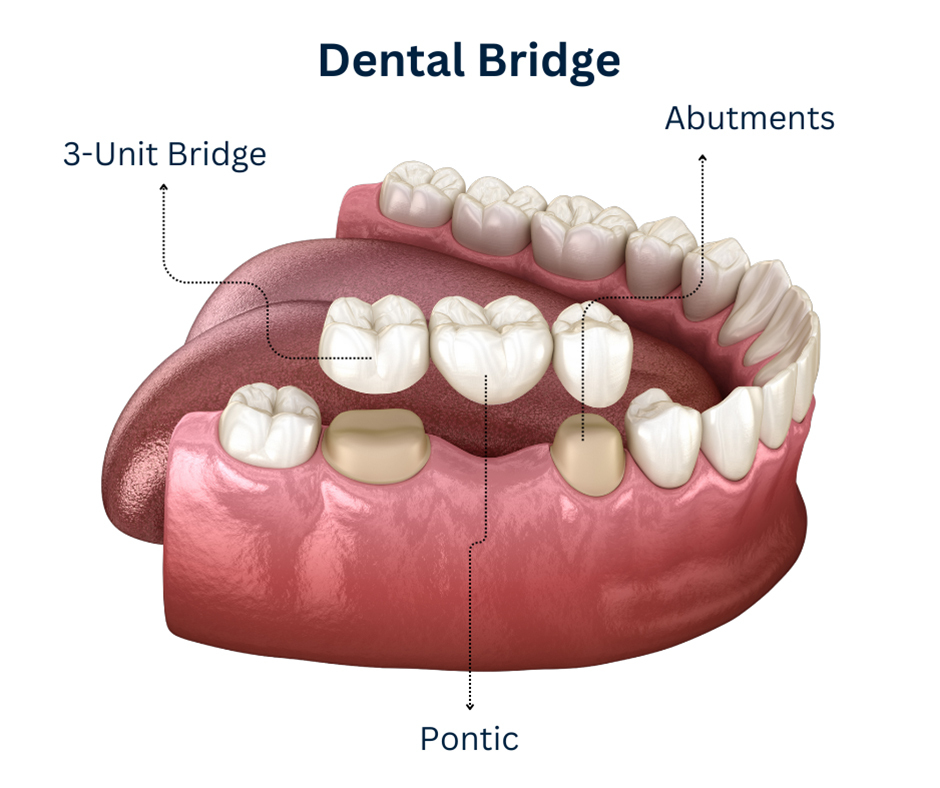
What is a Dental Bridge?

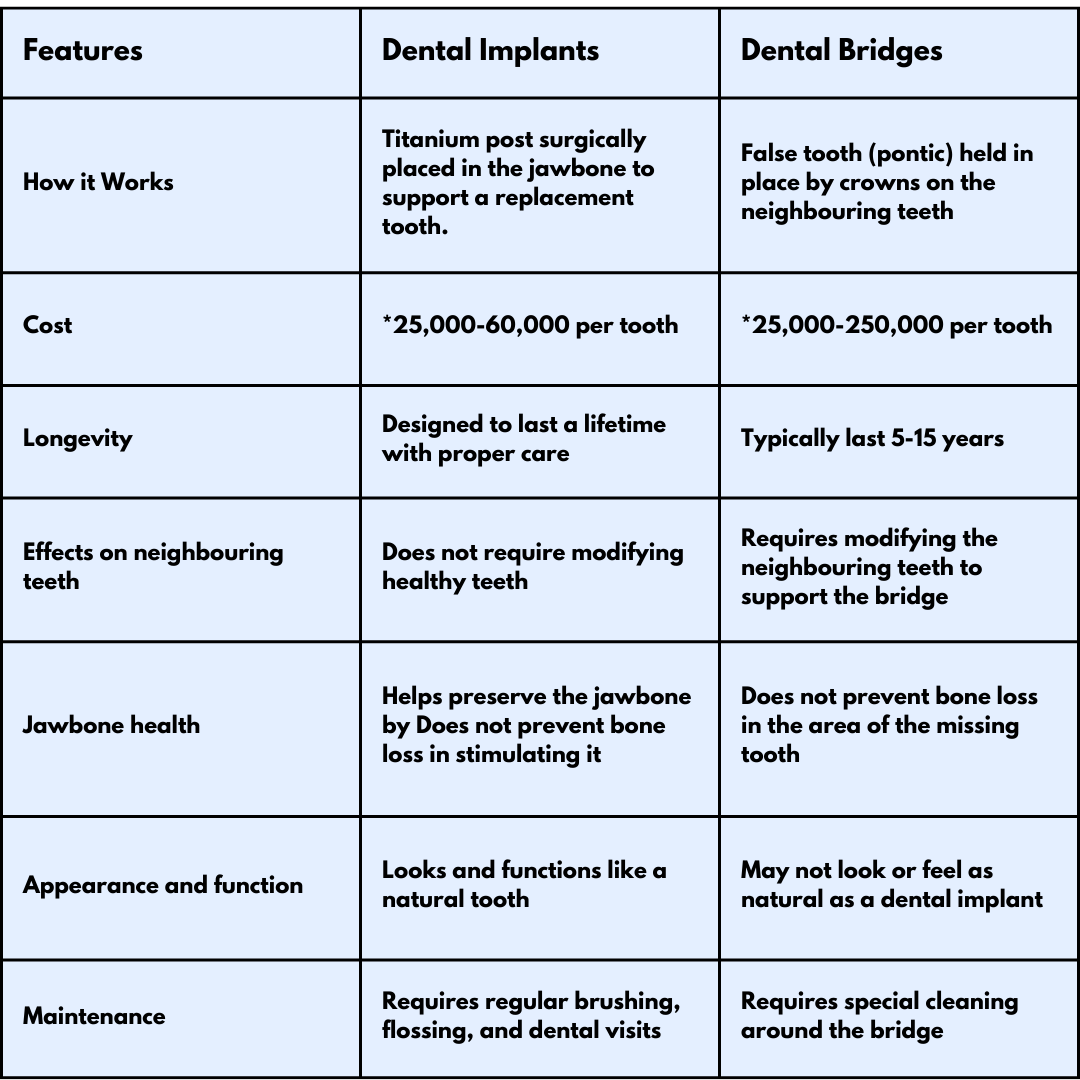
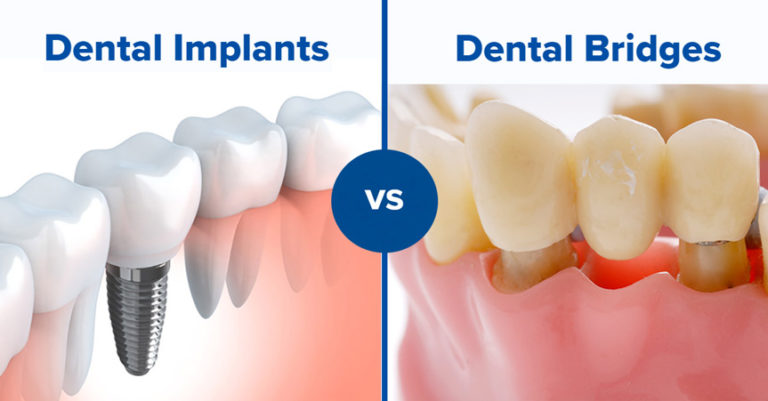
A dental bridge, as the name implies, literally “bridges” the space between teeth that results from a missing tooth. Therefore, the restoration needs anchoring to one or more neighboring teeth, which your dentist will have to file down so they can function as a support.

Bridges don’t replace your tooth root like implants. Instead, they use one or more of your surrounding teeth as a buttress for attaching a crown that fills the space of the missing tooth. A dental bridge can replace between one and four teeth, depending on the patient’s needs. It can replace more than four teeth in some rare cases, but there must be enough healthy teeth present to connect the dental crowns.

Here are some advantages of dental bridges.
  • Density: Jawbone density is not a problem.
  • Nonsurgical: You won’t require surgery.
  • Price: It’s less costly.
  • Less invasive: You can easily replace a tooth that has been missing for a while.
  • Fast: Bridges are faster to place than implants.

Dental Bridge Cons

Here are some of the downsides of dental bridges.
  • Jawbone deterioration: They don’t replace the root of your tooth, thereby causing the jawbone to degenerate more quickly.
  • Affects neighboring teeth: The crowned teeth neighboring the space can be more vulnerable to decay. Placement of the bridge also requires the removal of significant parts of the teeth neighboring the missing tooth or teeth.
  • Short lifespan: A bridge usually only lasts eight to 15 years before you will need to get it replaced.

Removable partial denture
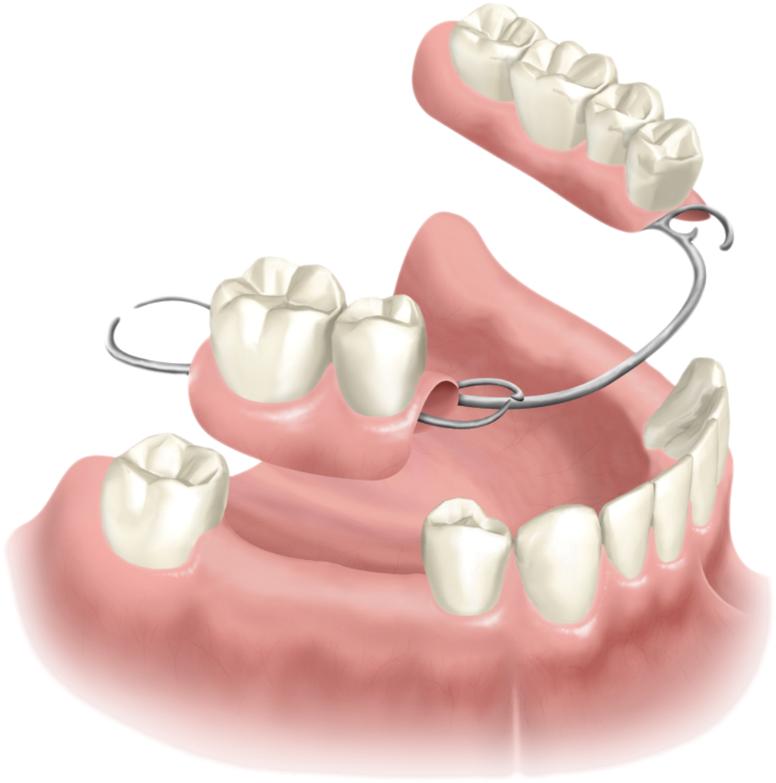
Most spaces can be filled with a removable denture. The primary advantage of this option is the reduced cost compared to that of bridgework or implants.  The procedure is also less invasive and reversible.  The difficulties that come with dentures tend to be many. Many people who wear partial dentures say they are reluctant to smile or laugh in public because they are afraid their denture may slip, or that the wires may show.  They can impact the ability to eat what you like.  Removable partial dentures can increase the build-up of plaque around the supporting teeth, which can lead to tooth decay or gum disease.  Pressure or movement of the partial can result in trauma to the surrounding teeth or gums.   Just like bridges, dentures do nothing to prevent loss of bone in the jaw.

A Dental Implant
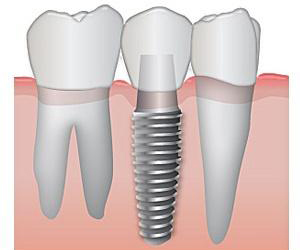
Rather than resting on the gum line like removable dentures, or using adjacent teeth as anchors like fixed bridges, dental implants are a long-term replacement for missing teeth.  They look, feel and function most like a natural tooth, mostly because they are fixed in place. Dental implants, if properly maintained, can last a lifetime.

In the case of implants, the positive tend to outweigh the negative.  No healthy teeth are damaged as part of implant treatment.  Not only is the gap left by the missing tooth filled, so is the root.  The implant integrates with the jawbone and the implant and crown perfectly mimic the function of a natural tooth.

One disadvantage is the length of the treatment.  Often, the implant is placed and there is a waiting period of 1-3 months before applying the crown, so that the implant can fuse with the bone.  Another drawback is cost.  However, a dental implant is a one time cost and it preserves the other healthy teeth, gum and bone in your mouth.  The other options may need to be replaced once or twice in a lifetime and can cause further damage.  In the end, the other options may wind up to be costlier.

Consequences of not replacing a missing tooth

Teeth are arranged in the jaw in such a manner so that they support one another and withstand the chewing forces together as a team. When one is lost without being replaced, teeth begin to move out of position and alignment However, the instability that occurs with dental collapse happens over a period of time. The signs are not as obvious and damage is often taking place silently.

Supraeruption (Over-eruption)

When an opposing lower tooth is lost and not replaced it’s upper partner now has no opposition and begins to adapt to this new space by moving downward. In doing so, it loses contact with its neighbouring teeth on either side and begins to bite more heavily with the teeth in the opposing lower arch. The bite lost its ability to distribute an equal force among all the teeth, and this can cause headaches, jaw tension, root exposure, tooth breakage, grinding, clenching and wear.

Tipping

When a tooth is lost and not replaced, the bone shrinks in the space and the teeth on either side now have a vacant area in which to tip and move into. In doing so, they lose contact with their other adjacent teeth. 

Loss of Contact

Teeth are designed to touch one another to prevent food impaction that can damage tissue and cause cavities. 

Plaque and Food Impaction

Aside from the first space that was created by the missing tooth, more spaces begin to develop as adjacent and opposing teeth begin to move out of their original positions. Plaque and food accumulation leads to cavities, gum and bone destruction and gum disease.

Bone Loss

When a tooth is removed there is no longer the need for bone and it resorbs (shrinks) away. Healthy, dense bone is an important factor when considering the placement of implants for replacement. The longer you leave the space, the smaller the height and width of the bone becomes

Tooth Decay

With increased food impaction comes a higher incidence of tooth decay. 

Sinus Collapse

When an upper tooth is removed, over time, the floor of the sinus begins to collapse into the space where the tooth root used to occupy interfering with the space needed for a future dental implant.

Teeth sensitivity

The root of the tooth is covered with a tissue that is much less calcified and more sensitive than enamel. As a tooth moves out of its position when it over-erupts or tips, more of the root tissue will become exposed. Patients often notice more sensitivity to hot and cold sensations

TMJ 

An uneven bite can quickly become a TMJ issue. Clicking, popping jaw joints, grating sounds, pain in the cheek muscles and uncontrollable jaw or tongue movements are common side effects of the missing teeth.

Dental Implants

An innovative and effective solution to replace missing teeth – Dental Implants

Why dental Implants?

Tooth loss affects your whole body, including your bite, speech, and eating choices. Replacing your missing teeth with implants can be a great solution as they act just like your natural teeth, safeguarding and preserving your bone structure, oral health, and appearance.

Advantages of Dental Implants over other options:
  • Dental implants have a post surgically inserted into your jawbone, replicating a real tooth root and providing all the stimulation necessary to keep the surrounding bone strong and healthy. No other tooth replacement solution offers this benefit.
  • Dental implant teeth will not rot or decay, so there is no need to worry about cavities.
  • Dental implant teeth are very easy to care for, and if you have single dental implants, you can brush and floss around them exactly like your real teeth
  • When you have dental implant teeth, it protects your remaining natural teeth. Dental implants ensure these teeth cannot shift position and help share the load when you bite and chew food. Unlike dental bridges, there is no need to adapt or grind down natural teeth for support.
  • Dental implants can support single implant crowns, such as for front teeth implant, or dental bridges, including full arch dental bridges. These restorations are permanently fixed in place.
  • Provided you care for them properly, your dental implants should last you for many years to come, and are very long lasting.
  • Well-designed dental implant treatment provides a predictable outcome with enviable success rates of 95% or even higher.

Single tooth implants

Single tooth implants are the most technologically advanced way to restore missing teeth. They look and feel much like a natural tooth, and they can provide a lifetime of benefits, such as improved oral health, increased self-confidence, and enhanced quality of life. Single tooth implants can also help to prevent the shifting of teeth and the loss of bone mass. 

Implant-supported bridge:

If you have multiple missing teeth, implant-supported bridges can be used to replace them. Implant-supported bridges will provide you with a permanent, fixed and functional tooth replacement option. Generally an implant-supported bridge will consist of one of more ‘pontic’ crowns in the middle, surrounded by ‘retainer crowns’ that are attached to dental implants.

Implant-Supported Dentures

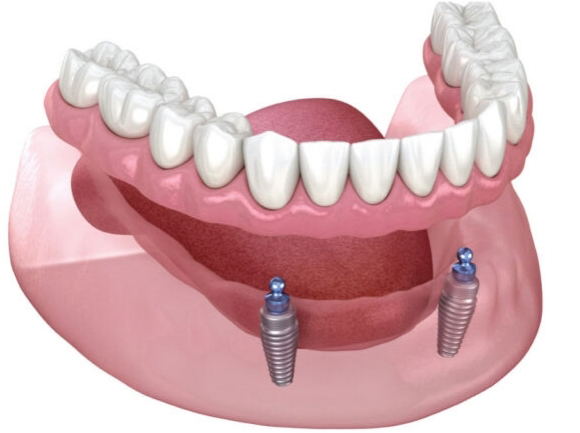
Implant-supported dentures are a relatively affordable implant treatment where only a few dental implants are needed to support a complete arch of teeth. Usually, anywhere between two to four dental implants are needed to support an arch of teeth, depending on whether you need the upper or lower jaw restored.

All-On-4/6 implants

A full arch implant-supported bridge prosthesis, also called a full arch reconstruction, replaces the entire dentition (all the teeth) on either the upper or lower jaws, or both. Missing teeth are replaced with a full dental bridge using only four or six implants in each jaw. All-On-4/6 implants are an excellent option for patients missing all or most of their teeth in the upper or lower jaw. Anyone in good overall health with sufficient jawbone mass may be a candidate for All-On-6 implants, provided they have healthy teeth and gum.

Caring for Dental Implants

Dental implants are easier to maintain than bridges. Implants can replace individual teeth while not affecting your other teeth, which makes routine home hygiene easier. To ensure the implant’s longevity, keep it clean and free of damaging plaque and bacteria that could cause gum tissue infection around your implant, leading to dental implant failure.

A slimy, thin film of bacteria called biofilm builds up in your mouth. When you don’t remove this, it can cause a damaging inflammatory process known as peri-implantitis to develop, resulting in implant loss.

Your dental hygienist plays a significant role in keeping your implants free of disease. If they use traditional dental hygiene scalers on your natural teeth, they can scratch an abutment, crown or implant. Therefore, the hygienist will use special tools made of resins and plastics instead to clean thoroughly without causing any damage.

You also have an essential role to play in the success of your implants, which should motivate you to care for them properly. At home:
  • Use a soft-bristled toothbrush to clean at least two times a day.
  • Brush around your implant crown and under it.
  • Use a low-abrasive toothpaste.
  • Use an oral irrigator.
  • Clean places that are hard to reach using a nylon-coated interdental brush.
  • Floss every day with implant-specific floss or unwaxed tape.

Preventing peri-implant disease is imperative to implant function and health, which is why an essential part of the success of your implant is how you care for it.

Dental Implant Cons

Some of the downsides of dental implants are as follows
  • Surgery: Your dentist will have to surgically attach the implant to the bone. There are always risks involved with any surgical procedure, including success rate, nerve damage, infection, jaw fractures, damage to surrounding teeth and more.
  • Time: You can’t get a dental implant in one office visit. Your bone takes time to heal, which means an entire implant procedure can take a few months.
  • Cost: The cost varies depending on the condition of your tooth and the type of implant you receive. Even so, the higher price tag of an implant is often what holds people back from considering this procedure.

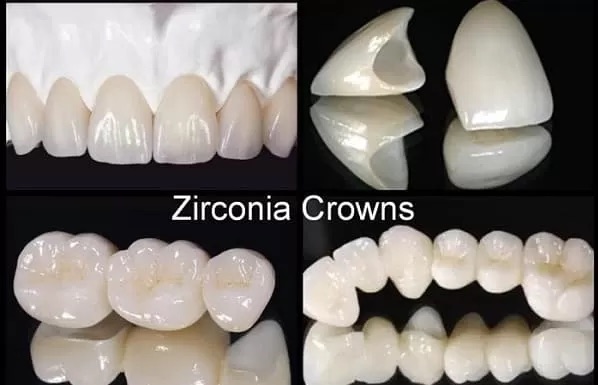
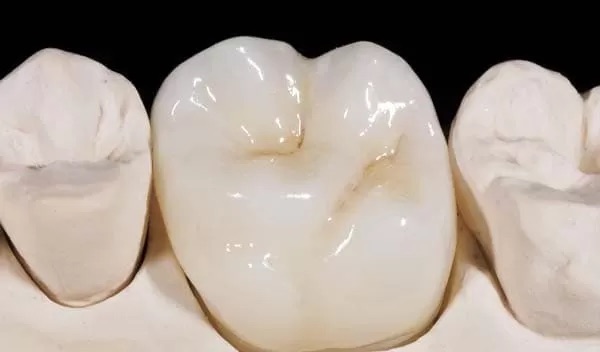
What are Zirconia Crowns?

Zirconia crowns are dental restorations made from zirconium dioxide. This material is tough and long-lasting in nature, making it an ideal choice for dental crowns. What sets zirconia crowns apart is their composition and the way they are made. These crowns are made from a special kind of zirconium dioxide, which is translucent in nature. This translucency allows light to pass through the crown, making them look like natural teeth

Who is an ideal candidate for a Zirconia Crown?

  • Individuals with decayed, chipped or broken teeth cannot be treated with dental fillings or other treatments.
  • Individuals with discoloured, dark, and stained teeth who want restorations that resemble their natural teeth.
  • Individuals with a large cavity or a missing tooth require a dental crown like a Zirconia crown to restore the look and function of their natural tooth.
  • Individuals with unevenly spaced teeth with large gaps, especially in the front region of the mouth.
  • Individuals who have crooked, rotated or misshapen teeth.
  • Individuals who have allergies to metals or other dental materials may find Zirconia crowns suitable, as Zirconia is biocompatible and does not cause any allergic reaction.
  • Individuals looking for crowns requiring minimal tooth preparation and preserving more natural tooth structure may benefit from Zirconia crowns.
  • Individuals who grind or clench their teeth or have other habits that cause their teeth to wear off may find zirconia crowns favourable due to their high strength and resistance to wear.

Advantages of choosing Zirconia Crowns

  • Zirconia crowns are highly biocompatible, as the smooth surface helps to reduce plaque accumulation. Layered zirconia crowns are highly durable. The material also promotes a healthy tissue response.
  • Zirconia is suitable for patients with metal allergies or who would prefer to have metal-free restorations.
  • Zirconia is metal-free, preventing darkening around the gingival margin in patients with thin biotypes. This eliminates the possibility of metal margins becoming exposed due to gingival recession.
  • \
  • The translucent nature of this material can transmit the color of adjacent teeth, and it is manufactured in a wide variety of shades, making it easy to match the color of the patient’s natural teeth accurately.
  • Computer-aided design and manufacturing processes provide patients with a precise fit, thus reducing the chairtime required to adjust and cement these restorations.
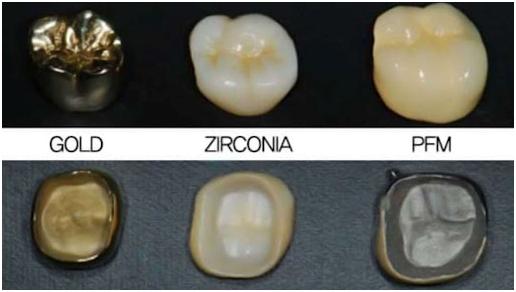
  • Zirconia crowns are comfortable for patients as they do not transmit hot and cold like conventional PFMs.
  • Due to a wide variety of factors, including chemical composition and processing requirements, there are many ways zirconia can be manufactured to suit the needs of the patient. This customization minimizes the margin for error and ensures an excellent fit for each individual.

Zirconia Crowns Disadvantages

  • The opaque appearance of some zirconia types can make the restoration look less natural than other crown materials.
  • Also, they can be pricier than crowns of other materials, which makes them less accessible for patient

In conclusion, Zirconia crowns offer a mix of strength, appearance, and compatibility for your gums. This means they're tough, they look nice, and they fit well with your gums, making them a popular option for getting your teeth fixed. If you have any doubts, it's always a good idea to talk to your dentist. They're experts and can give you all the information you need.

Braces

Orthodontic treatment is a branch of dentistry that involves improvement in the appearance and alignment of teeth, correct bite problems, and improve the long-term health of teeth, gums, and jaw joints using appliances. It can also help close gaps between teeth and align lips and teeth properly. 
Orthodontic treatment often involves braces, clear aligners, and retainers. Braces and clear aligners can help straighten teeth, correct bite problems, and close gaps between teeth. Retainers can help hold straightened teeth in place while the surrounding gum and bone adjust to their new position. Retainers can be removable or fixed.
Orthodontic treatment can help reduce the risk of oral health issues, such as cavities, gum disease, and excessive wear (erosion). Crooked or crowded teeth can be breeding grounds for bacteria, and aligning teeth can reduce the spaces where harmful bacteria can hide.
Teeth braces not only enhance your smile, but they also improve oral health and function. Today, there are many orthodontic options available. Your dentist or orthodontist can help determine the one that works best for you. Braces are an investment that can give you a healthy, beautiful smile for years to come.

How do braces work?

Braces use mild, constant pressure to shift your teeth into their proper positions over time. The exact way this happens depends on the type of braces you choose.

What are the types of braces?

There are several different types of braces. The type that’s best for you depends on a few factors, including the kind of issue you have, the severity of your condition and your personal preferences.

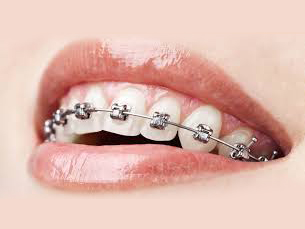
Metal braces

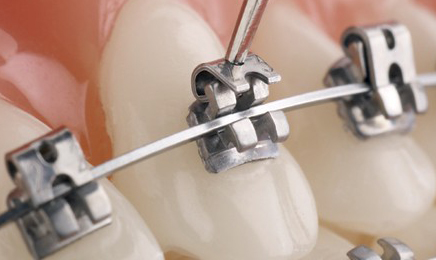
Self-ligating braces

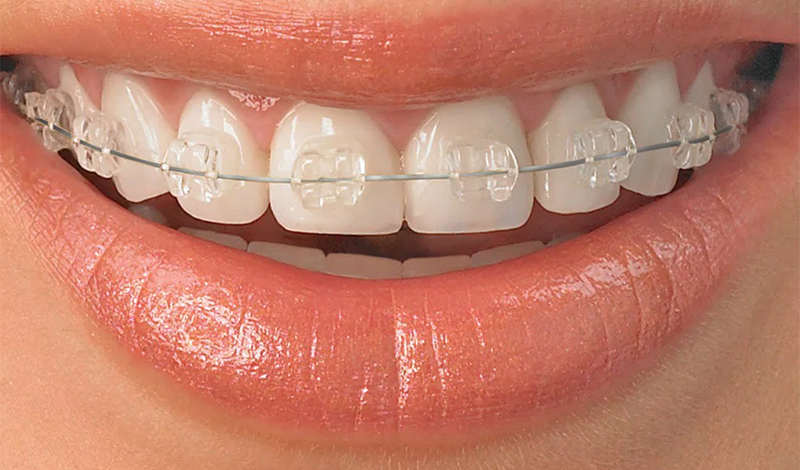
Ceramic braces

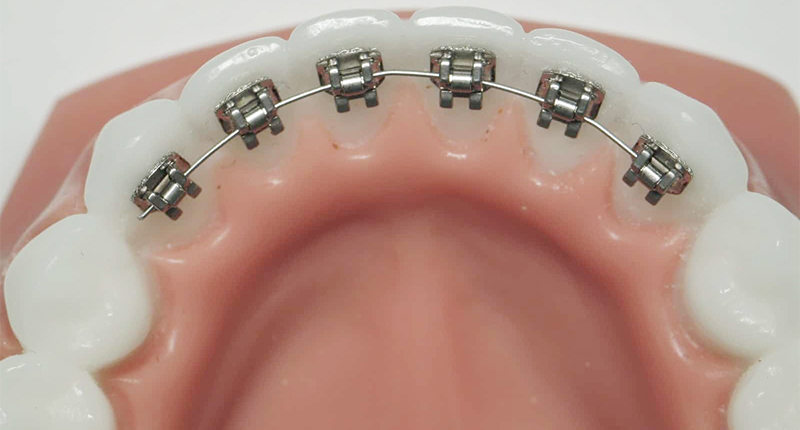
Lingual braces

What are the age of braces?

The best time for braces is generally between the ages of 9 to 18 years. At this point, your jaws and facial bones are more elastic and flexible because they’re still developing. But you are never too old for orthodontics. Adult braces are just as effective, but it might take a little longer to achieve the desired results.

Procedure Details

How long do braces take to work?

The answer to this question is different for everyone. On average, braces treatment takes about one and half to two years to complete. But it depends on the severity of malalignment. Some people also finish treatment in a year. Some may need as long as three years.

Risks / Benefits

What are the benefits of dental braces?

The most obvious advantage of braces is a straighter, more beautiful smile. But braces can also:

  • Make your teeth easier to clean.
  • Help prevent cavities and gum disease
  • Correct temporomandibular joint (TMJ) disorders
  • Restore proper functions like chewing and speaking.

In short, braces can improve the health, function and appearance of your smile.

What are the normal side effects of braces?

There are some mild, expected side effects of braces, including:
  • Temporary discomfort (which usually occurs the first day and any time your dentist tightens your braces).
  • Irritation on your tongue, lips or inner cheeks.
  • Jaw pain
  • Difficulty eating (especially after a tightening).

You can manage most of these side effects with over-the-counter (OTC) pain relievers. dental wax is also available for braces to help with irritation inside your mouth. Simply place some wax over any rough-feeling brackets or wire.

Recovery and Outlook

Do braces hurt?

You'll likely have discomfort for a few days after you get your braces. Some people experience tenderness after routine tightening, too. But generally, your braces shouldn't hurt.

To ease discomfort after your orthodontic appointments, you can take acetaminophen. It's best to avoid ibuprofen and other nonsteroidal anti-inflammatory drugs (NSAIDs). Research shows that NSAIDs block prostaglandins hormone-like substances that help with healing. As a result, NSAIDs can actually interrupt the tooth movement process.

How should I care for my braces?

Proper  oral hygiene  is even more important when you wear braces.  Plaque  and tartar can build up around your brackets and wires, leading to cavities and gingivitis.

Your dentist or orthodontist will give you a detailed list of instructions for taking care of your braces. But here are a few general guidelines:
  • Brush your teeth at least twice a day using a soft-bristled toothbrush and fluoride toothpaste.
  • Floss between your teeth and around your braces once a day. (Ask your dentist or orthodontist about special floss for braces.)
  • If you have clear aligners, clean them every day and store them properly when you’re not wearing them.
  • Swish with an alcohol-free, antibacterial mouthwash twice a day.
  • Avoid hard, crunchy or sticky foods.
  • Visit your orthodontist regularly for tightening and maintenance.
  • Visit your dentist regularly for cleanings and routine dental care.

What can you eat with braces?

After you get your braces, you’ll want to stick to soft foods for a few days.

Good options include:
  • Khichdi
  • Daliya
  • Upma
  • Mashed potatoes
  • Scrambled eggs
  • Soup.
  • Oatmeal.

Once the discomfort wears off, you can start adding other foods to your diet.

You should avoid certain hard and sticky foods the entire time you have braces. This includes nuts, caramels and crunchy fruits and veggies.

How can I maintain my results after braces?

Anyone who wears braces will need to wear a teeth retainer when they’re done with treatment. A retainer prevents your teeth from shifting back into their old positions. There are many types of retainers. Your dentist or orthodontist will help choose one that’s right for you.

When To Call the Doctor

When should I call my dentist or orthodontist?
Call your healthcare provider if you have:
  • Pain that doesn’t go away with medication.
  • Broken wires or brackets.
  • Trauma to your mouth or face.
  • Bleeding or infection in your gums.

Additional Common Questions

Invisalign vs. braces: Which option is right for me?

This is something only your dentist or orthodontist can tell you. But generally, Invisalign can correct most mild to moderate orthodontic issues. If your case is severe, traditional braces might be more suitable.

Clear Aligners

Dental aligners, also known as clear or invisible aligners, have been popularised in recent years as a discreet alternative to traditional metal braces.

What are aligners and why are they used?

Clear teeth aligners are orthodontic devices used to reposition and straighten teeth, with minimal impact on the wearer’s everyday life. This is because the retainer-like device is designed to be removable, and is almost invisible during use.

Aligners can be beneficial in many circumstances, with typical treatable cases including:
  • To straighten teeth which are crooked, overcrowded or gapped.
  • To treat bite issues such as overbites, underbites or crossbites.
  • To recorrect teeth which have moved after having braces.

Dental aligners are most successful when treating mild to moderate issues of overcrowding and spacing. For more severe cases of jaw misalignment, surgery often is a more effective solution. It is always recommended to first speak with an orthodontist to understand the best course of action for you.

How Do Teeth Aligners Work?

Similar to traditional braces, aligners work by exerting gentle pressure to gradually straighten teeth over a period of time. Tooth movement is directed by each individual aligner, and teeth will move approximately 0.2mm to 0.3mm with each new set. Tooth-coloured attachments may be applied to your teeth to anchor the aligners and facilitate the tooth alignment process. Getting aligners is simple, and considerably less invasive than traditional metal braces. Usually, only one or two appointments with an orthodontist are required before beginning the course of aligners. 

What Are the Benefits of Aligners Compared to Metal Braces?

Although the fundamental function of clear aligners and metal braces is the same, there is some distinction between the two. Many of these differences are seen as reasons to opt for teeth aligners, such as:

  • Aesthetics: For those who consider traditional metal braces a little too eye-catching, clear aligners are a more discreet teeth straightening solution. Aligners do not use brackets and wires and are able to be removed at any point.
  • Oral hygiene: Teeth aligners relieve some of the additional care required for traditional braces. Brushing and flossing are easier with removable aligners, and there are fewer restrictions on food and drink.
  • Fewer appointments: Although there can be variation, aligners usually require fewer orthodontic appointments during the teeth straightening process. Brace tightening is not necessary and there is less chance of emergency fixes being required.

However, there are certain drawbacks to keep in mind compared to metal braces. For example, aligners. It’s also likely that metal braces will be more effective for those with more complex alignment issues. There will also be some differences in cost, depending on the system in use and duration of treatment.

Can you eat, drink or smoke with aligners in?

It is generally recommended to remove your aligners when eating, to ensure cleanliness and avoid trapping food particles. Most drinks should not cause issues when wearing aligners. However, darker drinks such as coffee and red wine may stain, in which case it is recommended to remove aligners. Smoking is not recommended when wearing aligners, as the nicotine and tar can stain the clear trays.

What do I do with my old aligners?

After you’ve finished with an aligner tray, you should hold onto it until you’ve completed the alignment process. This helps your orthodontist if a movement was not fully achieved. Your orthodontist will then advise you on how to dispose of your old aligners at the end of the treatment.

How do I clean my aligners?

There are several steps you should take to clean your aligners on a nightly basis. These include:
  • Rinsing them with water
  • Brushing them with their own soft-bristled toothbrush and a gentle liquid soap
  • Storing them in a protective case when not in use

Invisalign Aligners

Clear & Comfortable Teeth Straightening

Dental Image 1
Dental Image 2

Invisalign is an advanced orthodontic treatment that uses a series of clear, removable aligners to straighten teeth gradually. These aligners are custom-made using digital scans and advanced 3D technology to ensure a precise and comfortable fit.

Unlike traditional braces, Invisalign aligners are nearly invisible, making them an excellent choice for adults and teenagers who want to improve their smile discreetly.

How does Invisalign work?

Invisalign treatment involves wearing a series of aligners that gently move your teeth into their correct positions. Each aligner is worn for about 1–2 weeks before progressing to the next set in the series.

What problems can Invisalign treat?

Invisalign can effectively treat mild to moderate orthodontic issues such as:

  • Crowded teeth
  • Gaps between teeth
  • Overbite
  • Underbite
  • Crossbite

Invisalign Aligners

Invisalign Aligners

Invisalign aligners are made from advanced, smooth, BPA-free medical-grade plastic that is custom-designed to fit your teeth precisely. Each aligner is digitally planned to apply gentle, controlled pressure on specific teeth, ensuring gradual and predictable movement without damaging surrounding tissues.

Since Invisalign aligners are completely removable, patients can enjoy their regular diet without food restrictions and maintain excellent oral hygiene. Brushing and flossing can be done normally, reducing the risk of plaque buildup, cavities, and gum disease that are commonly associated with fixed braces.

Ideal age for Invisalign

Invisalign is suitable for teenagers and adults. There is no upper age limit, provided that the teeth and gums are healthy. Teen Invisalign options are also available for growing patients.

Procedure Details

How does Invisalign treatment work?

The Invisalign process begins with digital records such as scans, X-rays, or impressions to accurately assess your teeth and bite.

Personalized treatment planning

A customized 3D treatment plan is created to map each stage of tooth movement, allowing you to preview your expected smile results before treatment begins.

Custom aligner fabrication

A series of custom-made clear aligners are produced using advanced 3D printing technology and provided to you for guided, step-by-step teeth straightening.

How long does Invisalign treatment take?

Treatment typically takes 6–18 months, depending on case complexity. Aligners must be worn 20–22 hours daily for best results.

Benefits of Invisalign

  • Nearly invisible appearance
  • Removable and convenient
  • More comfortable than braces
  • No food restrictions
  • Easy oral hygiene maintenance

Are there any side effects?

Mild discomfort or pressure may occur for a few days when switching to a new aligner. This is normal and indicates that the aligners are actively moving the teeth.

Recovery and Outlook

Does Invisalign hurt?

Invisalign is generally more comfortable than traditional braces and other clear aligners. Any discomfort is temporary and subsides within a few days.

How should I care for Invisalign?

  • Clean aligners daily with a soft toothbrush
  • Remove aligners before eating or drinking
  • Brush and floss before reinserting aligners
  • Store aligners in their case when not in use

What can you eat with Invisalign?

Since aligners are removable, you can eat all types of food. Always remove aligners before eating and clean your teeth before placing them back.

When To Call the Dentist

Contact your dentist if you experience:
  • Persistent discomfort
  • Cracked or lost aligners
  • Difficulty wearing aligners
  • Gum irritation or swelling